

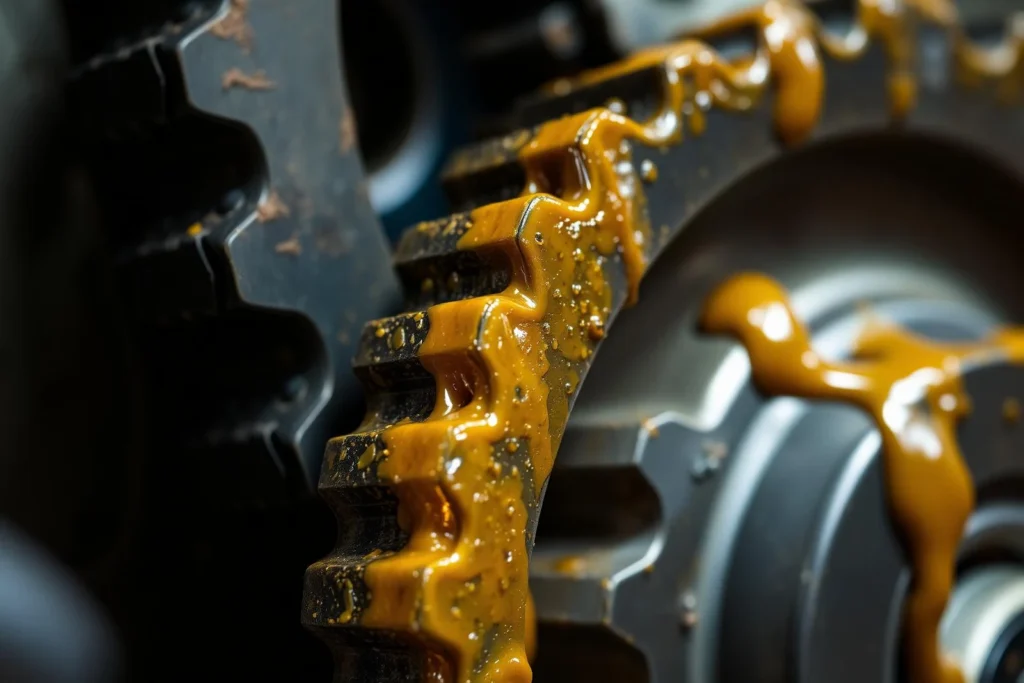
Not every gearbox needs the same oil. Operating speeds, loads, temperatures, and manufacturer specifications all influence which lubricant belongs in the equipment.
That’s where Comet comes in. Our Gearlube products provide options across multiple viscosity grades, and we’ll help you determine which industrial gear oil fits your application. Tell us what equipment you’re running, what you’re using today, and whether you’re experiencing any problems. We’ll help you find the right gear lubricant without making you sort through the options alone.

Compressor oils must perform under demanding operating conditions, where temperature, contamination, fluid life, and cleanliness can all affect equipment reliability.
Comet supplies compressor oil through our supplier relationships, including CITGO, with options for different compressor types and manufacturer requirements.
We help customers evaluate viscosity grades, additive requirements, operating temperatures, water separation, and fluid condition when selecting or maintaining compressor lubricants.
We can also support routine oil sampling to help customers monitor fluid condition and identify potential problems before they become more serious.

Circulating lubrication places several demands on an oil, from protecting moving components to managing heat and separating from water and other contaminants.
Comet’s Galaxy R&O product family provides rust- and oxidation-inhibited lubrication for applications including turbines, air compressors, pumps, gears, bearings, and circulating systems.
Galaxy R&O is formulated with a rust and oxidation additive package rather than the anti-wear package found in Comet’s Saturn hydraulic fluid line. It offers low-foaming performance and is suitable for certain applications involving silver or silver-plated components.
We can help customers identify the appropriate turbine oil or circulating oil based on their equipment specifications and operating requirements.
Not every industrial application requires a heavily compounded lubricant.
Some equipment calls for a highly refined straight mineral oil without the additive packages found in other industrial lubricants.
Comet’s Stellar line consists of highly refined paraffinic mineral oils available in multiple viscosity grades. These products offer a high viscosity index, low pour point, and low carbon-forming characteristics.
We also supply P150 Mineral Oil as part of our industrial oil offering.
Whether you’re replacing an existing product or working from an OEM specification, our team can help determine which mineral oil formulation is appropriate for your equipment.
Beyond our principal product families, Comet can help customers source industrial fluids for applications involving:
If you have an equipment specification or an existing product that needs to be matched, start there. We’ll help you determine what is available and what meets the application requirements.
Sometimes customers know exactly which lubricant their equipment requires.
Other times, they have an old product number, an unfamiliar specification, or a machine whose original recommended oil is no longer readily available.
Either way, we can help.
OEM specification matching and lubricant cross-referencing are a regular part of our work at Comet. Give us the manufacturer, equipment model, part number, existing lubricant, or specification you have available, and we’ll research the requirements and identify suitable options.
That might mean finding an equivalent product within our own industrial oil lines or sourcing an appropriate lubricant through one of our supplier partners.
We can also help identify products that satisfy multiple equipment requirements, provided they meet the applicable specifications.
You don’t have to become a lubrication expert just to keep your equipment running.
That’s what we’re here for.

One of the simplest ways to improve a facility’s lubrication program may be to take a closer look at the products already sitting in inventory.
When customers ask us to match an OEM specification, we can review their purchasing history and determine whether a lubricant they’re already buying from Comet meets the new requirement.
Sometimes it does.
Sometimes the right recommendation isn’t a new product at all. If a lubricant you’re already purchasing meets the equipment’s specifications, we’ll tell you. It’s one way we help customers simplify inventory and purchasing while making sure each machine gets the lubrication it requires.
The objective isn’t to make one oil work everywhere. It’s to identify opportunities to simplify without compromising the application.

Industrial lubrication problems don’t always begin with a catastrophic equipment failure.
Sometimes the first sign is oil that breaks down sooner than expected. Maybe it’s getting dirty unusually quickly. Perhaps the equipment is running hotter, water is entering the system, or the lubricant is beginning to foam.
Those symptoms deserve attention before they develop into more expensive problems.
Comet helps customers investigate issues such as:
For example, when water enters an oil system, the lubricant’s ability to separate from that water can become an important consideration. A product with more suitable demulsifying characteristics may be part of the solution.
But the first step is understanding what’s happening.
We’ll work with you to evaluate the application, current product, operating conditions, and symptoms before recommending a change.
Sometimes a different lubricant is needed. Other times, the issue may involve contamination, operating conditions, or maintenance practices that need to be addressed.

A lubricant doesn’t stop being important once it’s delivered and poured into the machine.
Its condition can change over time, particularly in equipment that operates continuously or under demanding conditions.
Comet supports customers with oil analysis and routine sampling programs that help provide a clearer picture of what’s happening inside their equipment.
Through laboratory testing, customers can monitor fluid cleanliness and condition, evaluate whether an oil is approaching the end of its useful service life, and identify indicators of potential equipment problems.
Routine oil sampling gives customers a way to monitor lubricant condition rather than waiting for an obvious performance problem.
We can provide sampling bottles for submission to an outside laboratory, with regular testing helping establish trends over time. Our team can then help customers evaluate concerning results and determine whether further investigation or corrective action is needed.
That technical support is part of what customers receive when they work with Comet.
We’re not simply here to sell another drum of oil. We’re here to help you make an informed decision about what your equipment needs.